
The Three-Bucket Method: A Practical Framework for Stretching a Flat Merit Budget
If you are responsible for stretching a fixed merit budget while protecting your most critical talent, this situation probably feels familiar: Your budget is set. Expectations are high. And every allocation decision now carries real consequences for retention, engagement, and credibility.
The challenge is not deciding whether to reward performance; it is deciding how. It is deciding where limited dollars matter most, and being able to explain those decisions with confidence.
The three-bucket method is a practical framework for doing exactly that.
A Common Reality for Today’s Merit Cycles
Let’s say your merit budget is fixed at 3.5% of total compensation, consistent with what many organizations are seeing in current market data, which often ranges between 3.0% and 3.5%.
There is no cushion. No upside adjustment coming later. Just a hard ceiling and along list of trade-offs.
Uniform increases might feel fair, but they rarely protect your most critical talent, reflect role importance, or hold up under scrutiny. When everything gets treated the same, performance differentiation disappears and retention risk increases where it matters most. The issue is not the size of the budget. It is the lack of structure guiding how that budget gets distributed.
A Three-Bucket Framework to Help You Prioritize Your Investments
The goal is not to reward everyone evenly. The goal is to invest limited dollars where they protect performance, continuity, and future growth. This framework starts by segmenting your workforce into three clearly defined groups:
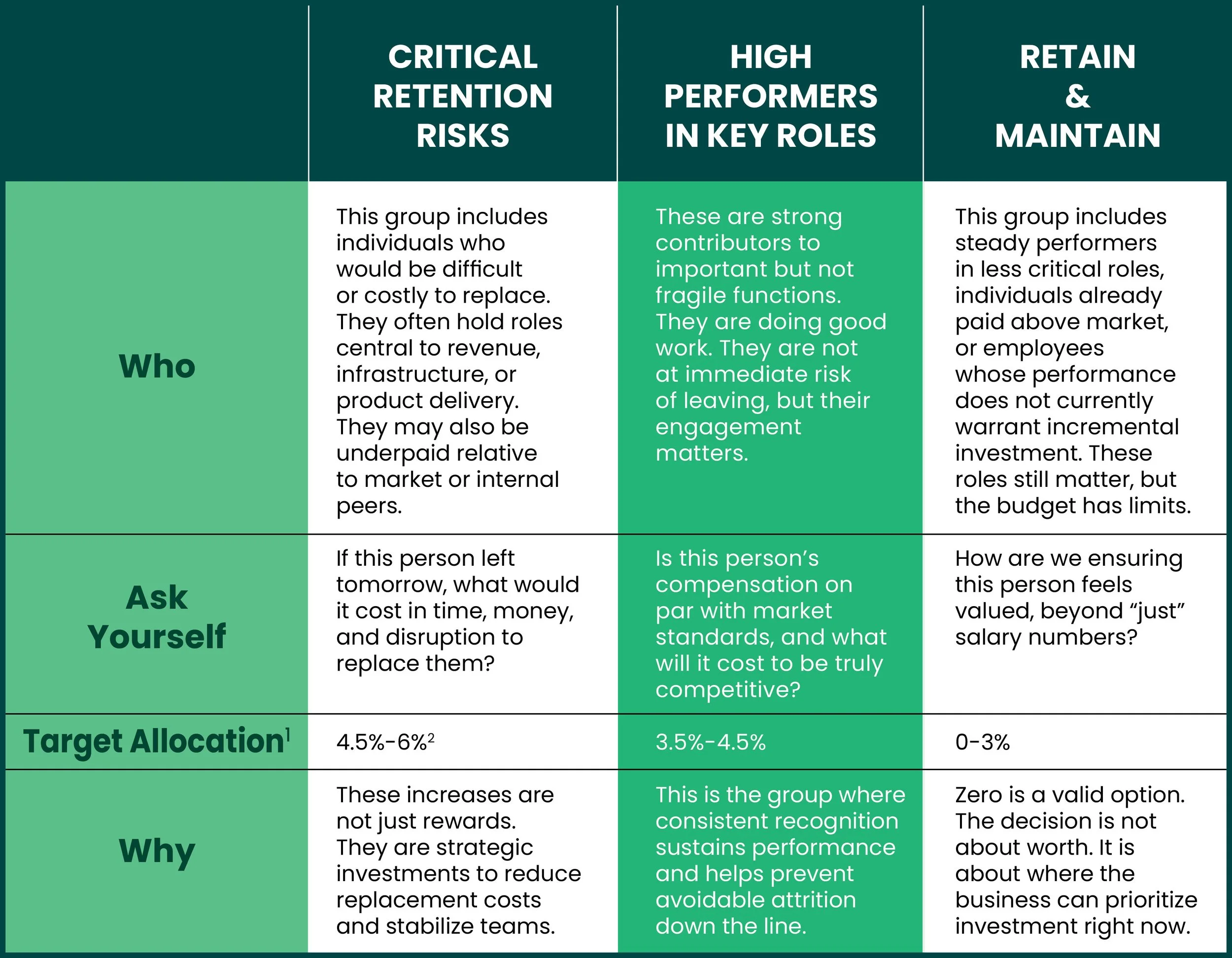
The framework ranges are directional, not guarantees. Even within a bucket, trade-offs still exist. This is where clear performance criteria and role differentiation matter most.
Teams that already use a defined career framework and leveling structure are better positioned to apply these ranges consistently. Without that foundation, merit decisions lack shared definitions of role scope and progression, and teams end up relying on subjective judgment rather than structure.
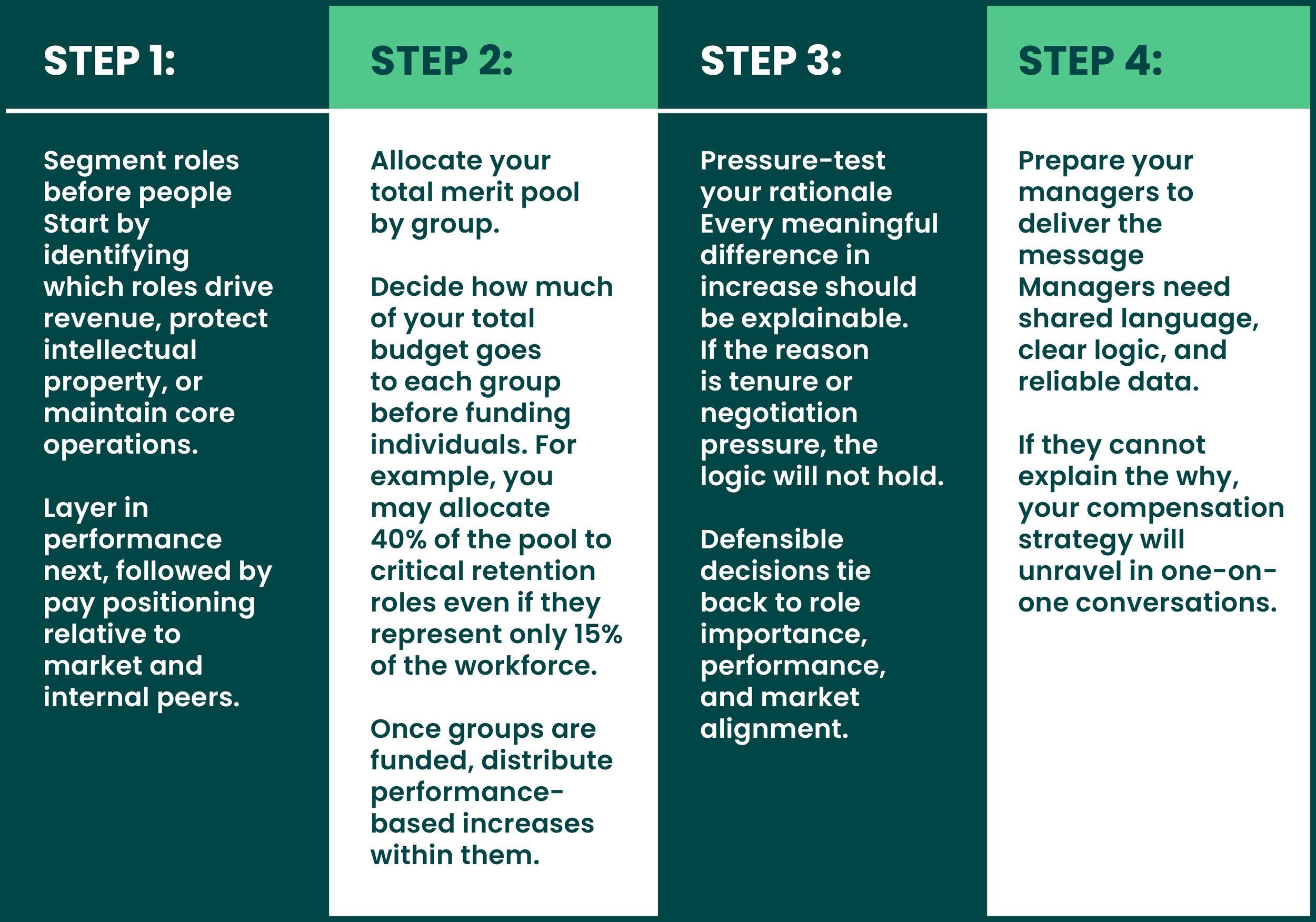
How to Apply the Framework
Why This Approach Works
This framework forces clarity. You can’t prioritize everything, so you decide what matters most. The trade-offs are real. Not everyone will get what they expect. But when decisions follow clear logic rooted in business impact, performance, and market relevance, employees are far more likely to trust the process.
Trust in compensation is built through consistent reasoning and transparent explanations, not universal raises.
Why Execution Breaks Down
Many teams want to work this way. Execution is where things fail.
Manually segmenting hundreds or thousands of employees is time-consuming and error-prone. Spreadsheets struggle under complexity. Data goes stale. Manager overrides create inconsistency. Equity analyses break down when exceptions pile up faster than teams can govern them.
That’s where most merit cycles lose credibility. Not because the strategy is flawed, but because the systems cannot support it.
Paidwell was built to operationalize frameworks like this at scale.
We help compensation leaders:
● Segment their workforce with clarity and speed.
● Allocate merit budgets using real benchmarks and consistent logic.
● Equip managers to explain pay decisions without chaos or confusion.
If your last merit cycle didn’t reflect your best thinking, the problem is not your strategy. It is the system supporting it.
We can help you fix that.