
Diagnosing and Addressing the Rise of Job-Hugging in 2026
One trend that quietly took hold in 2025 and shows no signs of slowing in 2026 is job-hugging.
Employees, especially mid-career top performers, are staying put. It’s not because they’re thriving, but because systems do not give them a clear, low-risk path forward. Today’s market leaves even the strongest employees with a lot of uncertainty about their next move and whether a big leap is worth the risk.
And while low attrition might look like a win at first glance, it often hides something more costly: a talent bottleneck.
The term may be new, but the problem is not. What many teams are calling job-hugging is usually a sign that career frameworks and progression standards are unclear, inconsistently applied, or disconnected from compensation decisions.
What Is Job-Hugging and Why Does It Matter?
Job-hugging shows up when employees stay in roles they have outgrown, not because they lack ambition, but because the system does not clearly show what comes next or how to get there.
These are often loyal, capable employees. They may even be some of your top performers. But they aren’t moving, and that holds everyone else back.
In most cases, the bottleneck is not talent. It is the absence of clear career levels, readiness standards, and progression signals leaders can stand behind.
Job-hugging quietly slows down your ability to move talent, test ideas, and build momentum. And if you don't deal with it early, it becomes much harder to unwind.
If you want to fix it, you need to know where to look
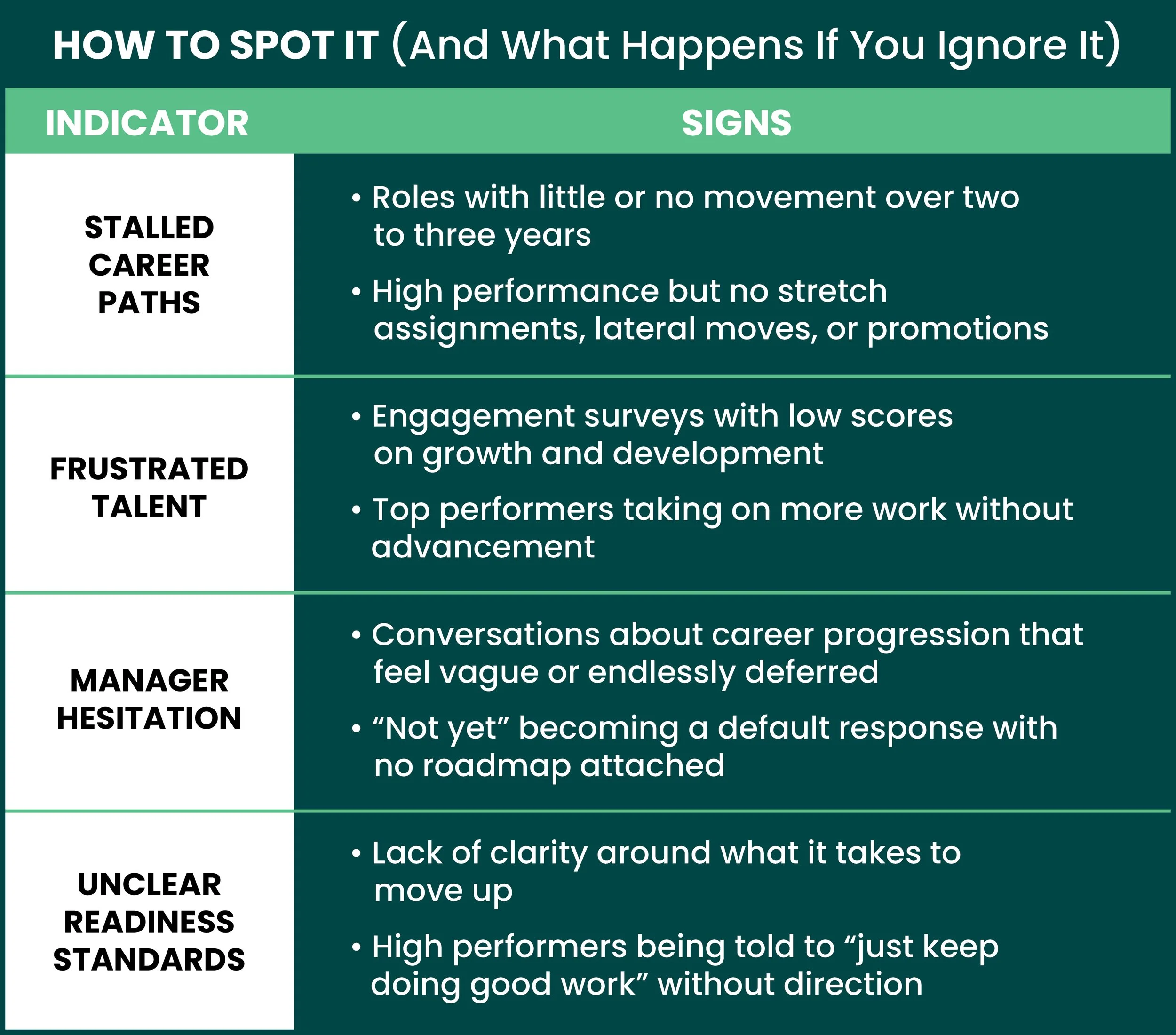
If this sounds familiar, the next step is not another retention initiative. It is getting serious about career frameworks and leveling that employees and managers can actually understand and trust.
Why Career Frameworks and Leveling Are the Real Fix
Job-Hugging is rarely solved by pushing people to move. It is solved by giving them a system that makes movement make sense. At its core, this is a career framework and leveling problem. When career paths are clearly defined, readiness standards are explicit, and pay progression is tied to real contribution, employees can be more self-directed. Managers can have honest conversations, and HR leaders can make decisions that scale.
This is where Paidwell comes in.
Paidwell helps teams build and operationalize career levels, progression standards, and pay structures that work together. Instead of vague signals or one-off exceptions, leaders get a shared framework for explaining what growth looks like, how compensation moves with it, and when movement is earned.
The result is not forced mobility. It is credible mobility, supported by data, structure, and consistency.